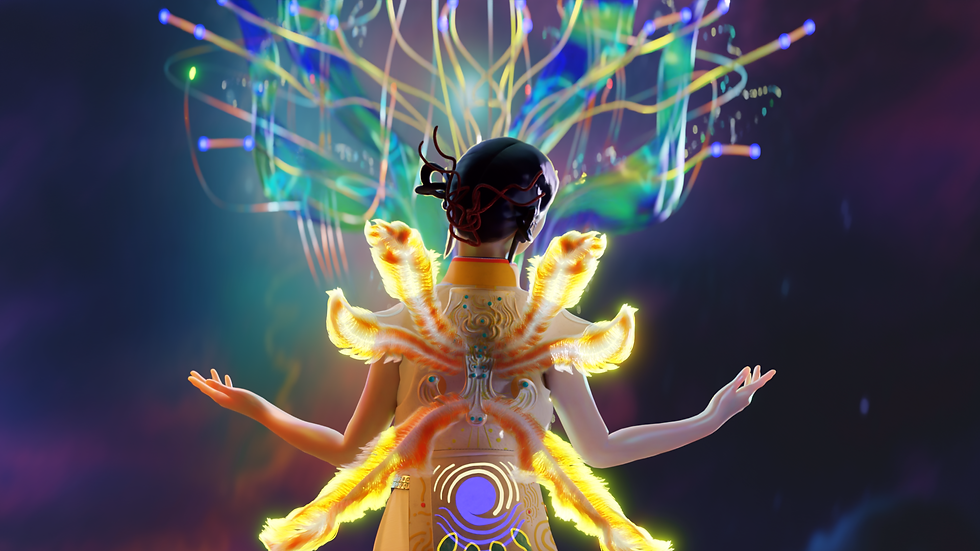


During the pandemic, Hatis Noit rediscovered a sense of truly being alive through the creation of Jomon. The project became a ritualistic process through which she reconnected with nature, people, and other living beings, reflecting on the deep relationship between life and death rooted in the hunter-gatherer era.
In translating this into the music video, the aim was to convey that raw feeling of aliveness and to celebrate the interconnectedness of all spirits and forms of life.
Exploring this theme—honoring life in both the physical and spiritual realms—presented a unique challenge.
Rather than relying on abstract imagery, the video immerses viewers in a tangible mythic narrative. Rituals performed by different tribes gradually converge into a larger, unified ceremony, guided and connected by Hatis Noit’s voice.


Jomon pottery has long inspired NAOWAO’s work, as well as artists such as Taro Okamoto. Its swirling motifs—linked to water, fire, and wind—are a defining feature of Jomon craftsmanship. These forms reflect a deep connection to nature and are also said to resemble snakes and frogs, symbols of fertility and regeneration. Together, they express a worldview rooted in reverence for the natural world.
Similar spiral patterns appear across many cultures, from yin and yang and Polynesian tattoo traditions to dragon imagery and Aboriginal visual languages. Across these contexts, swirls function as a shared symbolic language, representing cycles, energy, and humanity’s relationship with the environment.
Vessels such as vases and pots held deep meaning in many ancient cultures, often serving as bridges between the physical and spiritual worlds. In parts of Southeast Asia and among Native American societies, vessels were used to house ancestral spirits or remains, allowing the living to honor and seek protection from their ancestors. Across civilizations, they played essential roles in rituals and ceremonies.
The form and decoration of vessels carried cultural meaning, often depicting myths, values, and everyday life. Some were made specifically for ritual or civic use, giving them heightened symbolic power. In Vedic, Buddhist, and Jain traditions, vessels symbolized fertility and abundance and acted as containers for spirits or divine presence, often decorated with protective motifs.
Figurative vessels blur the line between sculpture and function. Though highly expressive, they remain hollow and usable—capable of holding water, food, medicine, or more symbolic contents such as memory, life energy, or healing.


In the music video Jomon, the world is portrayed as one where nature and culture are inseparable. The tribes who inhabit it are shaped by the land, and their rituals, traditions, and ways of life emerge directly from their environment.
Throughout human history, song and dance have served as bridges between the physical and spiritual realms. In Jomon, ritual becomes a way to communicate with unseen forces and to reaffirm a deep connection to nature. This idea echoes in Hatis Noit’s name, derived from the lotus stem—a symbol linking the visible and invisible worlds.
Animism forms the foundation of the video’s worldview. All beings, living and non-living, are understood to possess spirit, creating a continuous connection between the seen and the unseen. As poet Sansei Yamao described, calling “the earth a kami, water a kami” reflects a reverence for the elemental forces that sustain life.Dancing and singing rituals are central to Jomon.
The Frogolotls, an amphibious humanoid tribe, perform sacred dances within stone circles engraved with symbols of their cosmology. These circles represent two intertwined worlds—the mortal and the spiritual—connected through movement and rhythm. As the dance unfolds, the boundary between worlds is believed to grow thin.The landscape itself is alive and sacred. Mountains inspired by Nepal and Southeast Asia become active participants in the ceremony. As Hatis Noit sings, the earth resonates—gemstones and crystals glowing in response—transforming the land from a backdrop into a living presence within the ritual.


Integrating ancient Jomon aesthetics with biological metamorphosis, the project features five distinct spiritual entities.
The Avatar acts as a conduit between realms, featuring Magatama ornaments and collaborative embroidery that narrates a mythical history.
The Sea Chromo Tribe draws from nudibranchs and global ritual traditions to symbolize non-gendered life and the transcendence of physical boundaries through sacred masks.
The Frogolotls, a hybrid of axolotls and frogs, embody regeneration through a ritual dance choreographed by Sung-Im Her that translates biological transformation into a spiritual trance that connected the spirits of the creatures and the music. Through Sung Im’s movements, their ceremony came to life.
The Teno Tribe fuses realistic insectoid forms with Jomon motifs, echoing African ancestral traditions to represent the coexistence of tiny beings and natural energies.
Finally, The Sea Dragon Tribe symbolizes eternity, evolving from a snake into a majestic dragon to reflect the "mating snake" theory of Jomon pottery and the sacred vessel traditions of ancestral souls.


